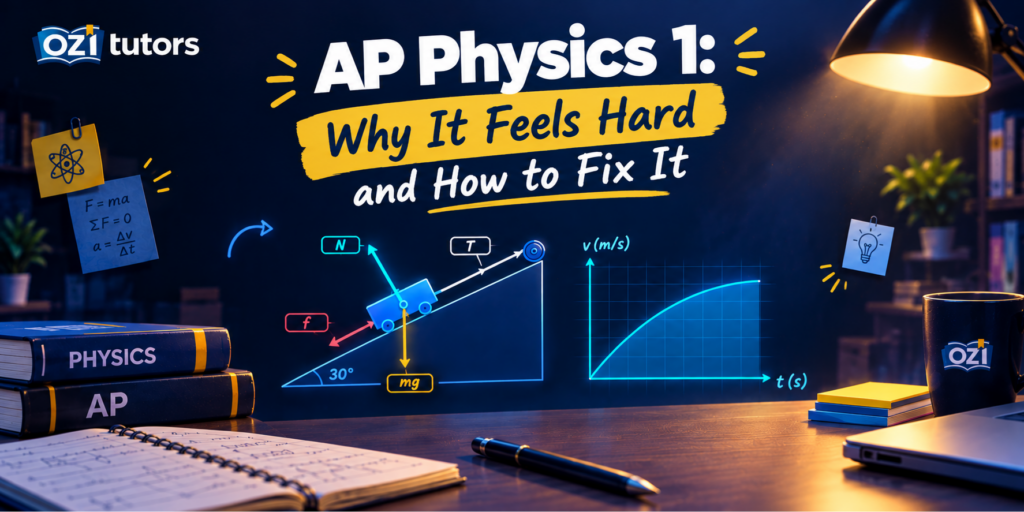
AP Physics 1 is an algebra-based course that tests conceptual reasoning as much as calculation. Students find it hard because they try to memorise formulas instead of understanding forces, energy and motion. Learn the ideas, draw diagrams, practise explaining answers in words, and review every mistake to improve.
AP Physics 1: Why It Feels Hard and How to Fix It
AP Physics 1 has a reputation for surprising students. Many walk in expecting a maths class and find something different. The problems may need only simple algebra, but the thinking behind them is not simple. Students who are used to plugging numbers into a formula find that this course asks them to explain why.
This guide explains why that happens and how to study in a way that works.
What does AP Physics 1 cover?
It is an algebra-based, introductory course in mechanics and related topics. Typical areas include motion, forces, energy, momentum, rotation, oscillations and mechanical waves. The exact units and weightings can change, so check the current course and exam description from the College Board.
Why do students find it hard?
There are usually four reasons.
- Formulas are not enough. Many questions ask you to explain, predict or compare. A formula alone cannot do this.
- Everyday ideas about motion are often wrong. Many of us believe a moving object needs a constant force, which is not what Newton’s laws say. The course tests this kind of misconception.
- Diagrams matter more than expected. Without a free-body diagram, forces are easy to miss.
- Written answers need clear reasoning. Students who can calculate still lose marks when they must justify.
Step 1: Learn the big ideas well
Focus first on a few core ideas that show up across the whole course:
- Newton’s laws and free-body diagrams
- Conservation of energy
- Conservation of momentum
- The link between force, work and energy
- Rotational versions of the same ideas
If these are firm, most other topics feel like variations.
Step 2: Always start with a diagram
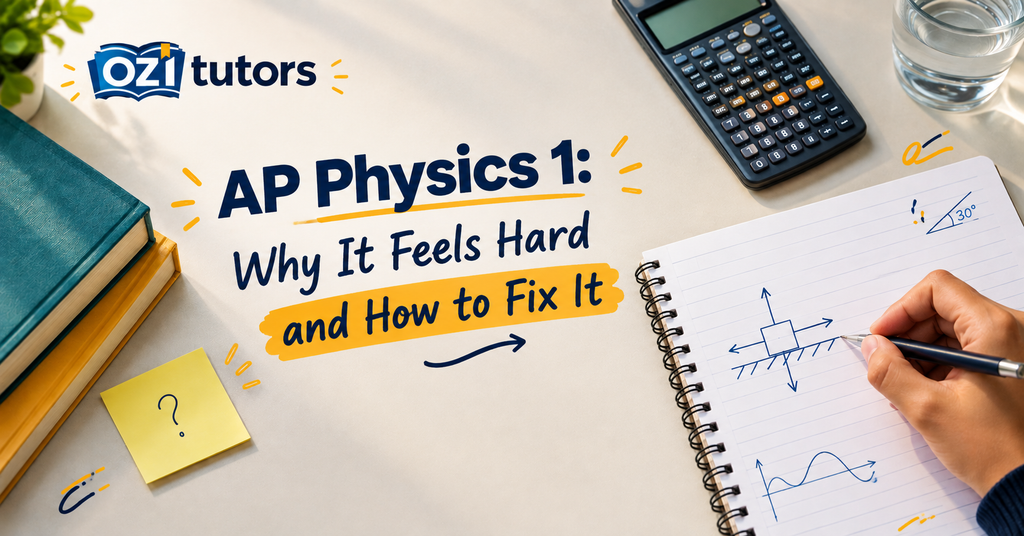
For any force problem, draw the object and every force acting on it. Label each force with a name, not just an arrow. Pick a direction as positive. Then write Newton’s second law for each direction. This takes an extra minute and saves many mistakes.
Step 3: Practise explaining in words
For every problem you solve, try to say in one or two sentences what is happening and why. If you cannot, you do not yet understand it. Free-response questions often award marks for a clear statement of a principle, such as “the net force is zero, so the velocity is constant”.
Step 4: Use graphs
Graphs of position, velocity and acceleration against time appear often. Practise moving between them. Ask what the slope means and what the area means. Many multiple-choice questions can be solved by reading a graph correctly.
Step 5: Work through the free-response section early
Do not save free-response practice for the last month. Write out full answers from past questions in the first months of the course. Compare them with the official scoring guidelines. Notice the kind of language that earns marks: short, accurate and connected to the physics.
Step 6: Keep an error notebook
For every wrong question, write down:
- What I thought
- What was actually true
- The rule or idea I should remember
Look at this notebook before every test. Misconceptions do not disappear on their own. You have to catch them.
Common mistakes to avoid
- Forgetting a force in the free-body diagram, especially friction or tension.
- Mixing up mass and weight.
- Using a formula outside its conditions, such as constant-acceleration equations when acceleration is changing.
- Skipping units.
- Writing “because of gravity” without saying what gravity does in this case.
A simple weekly routine
- Class days: read the chapter briefly before class, and solve a few problems after.
- Midweek: one set of problems mixing old and new topics.
- Weekend: one free-response question under time limits, then a careful review.
Getting extra support
Because so much of the course depends on understanding, a tutor who explains ideas in different ways can help a lot. Some students need to see the same idea through a demonstration, a graph and a simple example before it clicks. A one-to-one session gives you time to ask the questions you might not ask in class.
FAQ
Is AP Physics 1 harder than AP Physics C? They are different. Physics 1 is algebra-based and conceptual, while Physics C uses calculus. Many students find Physics 1 confusing at first because it needs careful reasoning.
Do I need calculus for AP Physics 1? No. It is algebra-based.
How many hours should I study each week? It depends on your class and goals. A steady few hours of practice, beyond class time, is better than last-minute cramming.
What score do I need for college credit? Credit policies differ. Check the policies of the colleges you are interested in.