
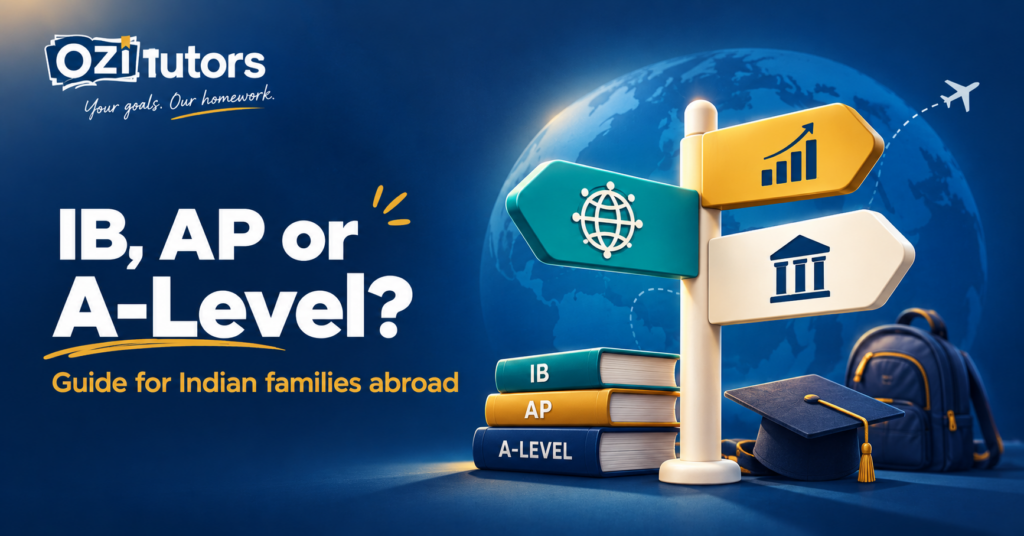
IB, AP or A-Level? A Guide for Indian Families Living Abroad
| The IB Diploma is a broad two-year programme of six subjects plus core components. A-Levels are about three subjects studied deeply, mainly for UK entry. AP lets students sit single college-level exams alongside a school diploma. The right choice depends on the country, the school’s offer and the target universities. |
If your family has moved to Dubai, Singapore, London or Toronto, someone will soon ask a question that sounds simple: which curriculum? The school might offer only one. Or it might offer two, and both look fine on paper. The catch is that this choice, made at Grade 9 or 10, quietly shapes what is possible at 17: which universities, which entrance exams, and whether a move back to India stays easy.
This guide explains the IB Diploma, A-Levels and AP in plain words. Then it looks at them from an angle most guides skip: an Indian family that may want India, the UK and the US all kept open.
What each one actually is
| IB Diploma | A-Levels | AP (Advanced Placement) | |
| Run by | International Baccalaureate | Exam boards such as Cambridge and Pearson Edexcel | College Board (US) |
| Structure | A two-year programme for ages 16 to 19 | Usually two years, ages 16 to 18 | Single-subject courses and exams, taken alongside a school diploma |
| How many subjects | Six, three at Higher Level and three at Standard Level | Usually three | The student chooses how many, subject by subject |
| Extra requirements | Theory of Knowledge, an Extended Essay and CAS | None | None for most courses |
| Grading | 1–7 per subject, up to 45 points in total | A* to E | 1–5 per exam |
| Strongest fit | Many countries, including India | UK universities | US colleges |
One thing to notice: AP is not a full programme like the other two. It is a set of separate exams. That is why it usually sits alongside a US-style school diploma, and why putting “AP” and “IB” side by side can mislead.
How each one is assessed
IB Diploma. Students sit final exams, mostly in May, and also complete coursework called internal assessments in most subjects. The Extended Essay is an independent research paper. Each subject is marked 1 to 7, and the core can add up to 3 bonus points, so the top score is 45. For more on choosing levels, read our guide to IB Standard Level vs Higher Level.
A-Levels. Most of the grade comes from final exams at the end of the course, in the May to June series. Grades run from A* to E, and UK university offers are usually written in these grades, for example AAB.
AP. Each course ends with an exam in May, scored from 1 to 5. College Board describes a 3 as qualified, a 4 as well qualified and a 5 as extremely well qualified. Whether a score earns college credit is decided by each college, not by College Board.
Where each one is recognised
These are general patterns, not promises. Always check the course page of the exact university, for the year you plan to apply.
- India. The Association of Indian Universities (AIU) treats the IB Diploma as equal to Class 12, and has done so for many years. For the IB, it asks for at least 24 points, with three Higher Level and three Standard Level subjects passed. A-Levels are also recognised as equal to Class 12. Some universities ask for an AIU equivalence certificate, so keep that in mind early. AP exams are not a school-leaving qualification, so recognition in India depends on the school diploma they sit beside, usually a US high school diploma.
- UK. A-Levels are the home qualification. The IB is widely accepted, with offers written in IB points. Some UK universities consider AP, usually alongside a high school diploma and with specific score requirements.
- US. Colleges read all three. AP and IB are the most familiar. Many colleges give credit or placement for strong IB and AP results, and some do for A-Levels, but every college sets its own rules.
- Canada and Australia. Both accept the IB and A-Levels for admission. Australian universities convert results to their own scale. Canadian universities often give credit for AP. Check each university’s page.
Which kind of student each one suits
These are general descriptions, not rules. Plenty of students surprise their teachers.
- IB Diploma. A student who enjoys many subjects, is happy to write and research over two years, and has not yet decided on a degree. It keeps doors open, but the workload is steady and wide. Find an IB tutor early if one subject feels shaky.
- A-Levels. A student who already leans toward a field, such as sciences or economics, and prefers going deep in three subjects. The narrowing happens early, so it suits students who are fairly sure. See A-Level tutors.
- AP. A student in a US-style school who wants to add challenge one subject at a time, or who is aiming mainly at US colleges. How good the experience is depends a lot on the school’s AP teaching. See AP tutors.
The India question
For many Indian families abroad, India is a “maybe”. It is worth keeping that option open without letting it decide everything. Two things matter: whether the child is eligible, and whether they can prepare.
Eligibility. Because the AIU treats the IB Diploma and A-Levels as equal to Class 12, students on these routes can usually apply to Indian exams and universities. Each exam still sets its own rules on qualifications and subjects, and they change from year to year, so read the current information bulletin. Our JEE Main 2027 guide shows how the January session is laid out, and the DASA and CIWG rank predictor helps with the college side for students based abroad.
Preparation. JEE and NEET follow the Indian Class 11 and 12 syllabus. Students on other curricula usually need to cover extra topics alongside school. Subject choice helps: Maths, Physics and Chemistry for engineering routes, and Biology, Chemistry and Physics for medicine. IB students would pick these at Higher Level, A-Level students would take them as their main subjects, and AP students would look at the matching AP sciences and calculus courses.
Availability and cost
In most places your choice is limited to what nearby schools offer. In general, British-curriculum schools run A-Levels, American-curriculum schools run AP, and international schools often run the IB. Some schools run more than one. Fees, subject lists and results vary a lot from school to school. Ask for the subject list, the full cost including exam fees, and the previous year’s results before deciding.
Six questions that settle it
- Where could my child realistically apply? Write down the top three countries, then read the entry requirements for two or three courses in each.
- Should India stay open? If yes, lean toward the IB Diploma or A-Levels with Maths, Physics, Chemistry or Biology, and check the exam bulletin each year.
- Does my child already know their subjects? If yes, A-Levels or AP can work well. If not, the IB’s breadth or AP’s pick-as-you-go approach gives more room.
- How does my child handle long coursework? The IB asks for steady project work across two years. A-Levels lean on exams at the end.
- What does the school actually offer, and how good is it? A strong school offering the second-best curriculum often beats a weak school offering the best one.
- What support will my child need? Think about which subjects are likely to be hard, and plan help before the pressure arrives, not after.
Key dates for 2027
Dates checked on 15 October 2026. Confirm your own timetable with your school, because local arrangements can differ.
| What | When |
| IB May 2027 exams | 23 April to 18 May 2027. Your school’s IB coordinator gives the exact subject dates. |
| IB May results | Early July 2027 |
| AP Exams 2027 | 3–7 May and 10–14 May 2027, with late testing on 17–21 May. See AP Exams 2027: dates and changes. |
| AP scores | July 2027 |
| A-Level exams | May to June 2027, with results in August. The exam boards set the exact days. |
| UCAS main deadline | 13 January 2027, 6pm UK time, for most UK undergraduate courses. Some courses close earlier. |
For all the major exams in one place, see our Global Exam Calendar 2026–27.
Frequently asked questions
Which is better for studying abroad: IB, AP or A-Level?
None is better in every case. A-Levels are the standard route into UK universities, AP fits the US system, and the IB is accepted in many countries. The best choice depends on where your child plans to apply and what their school offers.
Which one keeps JEE or NEET open?
The IB Diploma and A-Levels are both recognised by the Association of Indian Universities as equal to Class 12. Students can usually apply for Indian exams if they meet each exam’s own eligibility rules and subject requirements. Check the current information bulletin for the exam, because rules change from year to year.
Can a student take AP exams alongside CBSE?
Often yes. AP exams are separate from school boards, but the student needs a school or test centre that runs AP exams and registers them. Ask an AP coordinator whether a nearby school accepts outside candidates.
Is the IB harder than A-Levels?
They are hard in different ways. The IB is broader, with six subjects plus the core, while A-Levels are narrower and deeper. Which feels harder depends on the student, the subjects and the school.
Can a student switch between them later?
It is possible, but it gets harder after Grade 10. Some schools allow a change at the start of Grade 11, and the student may need to catch up on subjects. Talk to both schools early.
Choosing well
Most families end up deciding on three things: where the child may apply, what the school offers, and how the child learns. If you want a second opinion on subject choices, OziTutors runs IB, AP and A-Level tutoring, and the first lesson is free. You can book a free first lesson and ask anything you like. This guide is meant to help you choose, not to steer you.