
Every conductivity question on a chemistry exam — from IGCSE to AP Chemistry to JEE — comes down to one idea: electricity is carried through a solution by mobile ions, and the number of ions depends on how completely a substance dissociates. Once you can see that with particulate diagrams, the whole topic clicks.
The core idea in one sentence
A strong electrolyte dissociates ~100% into ions in water; a weak electrolyte dissociates only partially (often less than 5%); a non-electrolyte doesn’t form ions at all. More free ions → more charge carriers → brighter bulb in the classic conductivity demo.
The particulate picture
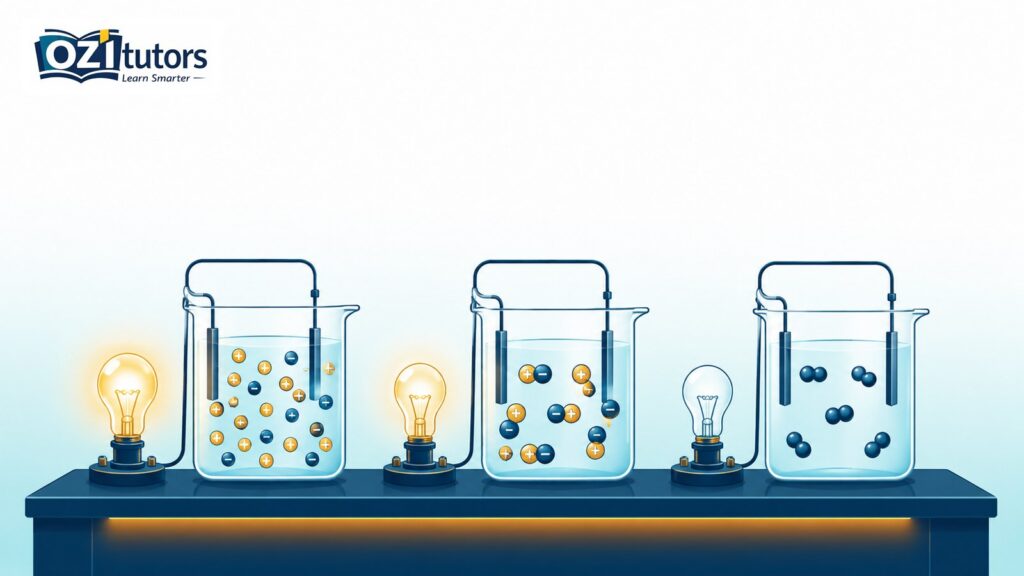
Imagine three beakers, each drawn at the particle level (this is exactly the style examiners use — see our full guide to particulate diagrams in chemistry):
- Beaker 1 — HCl (strong acid): no intact HCl molecules; the diagram shows only H⁺ (or H₃O⁺) and Cl⁻ ions, in a 1:1 ratio. Bulb: bright.
- Beaker 2 — CH₃COOH (weak acid): mostly intact CH₃COOH molecules, with only a few H⁺ and CH₃COO⁻ ions scattered among them. Bulb: dim.
- Beaker 3 — C₆H₁₂O₆, glucose (non-electrolyte): only whole molecules, zero ions. Bulb: off.
Exam tip: when asked to draw a weak electrolyte solution, the most common mark lost is drawing too many ions. Show the majority as intact molecules — that’s the point of the question.
Classifying common substances
| Category | Examples | Dissociation |
|---|---|---|
| Strong acids | HCl, HBr, HI, HNO₃, H₂SO₄, HClO₄ | ~complete |
| Strong bases | NaOH, KOH, Ca(OH)₂, Ba(OH)₂ | ~complete |
| Soluble ionic salts | NaCl, KNO₃, CuSO₄ | ~complete |
| Weak acids | CH₃COOH, HF, H₂CO₃, H₃PO₄ | partial |
| Weak bases | NH₃, amines | partial |
| Non-electrolytes | glucose, ethanol, urea, pure water* | none |
*Pure water self-ionises to a tiny degree (10⁻⁷ mol/L of each ion) — technically an extremely weak electrolyte, which is why deionised water barely conducts.
So — are bases conductive?
Yes, when dissolved in water — but how conductive depends on the base:
- NaOH (strong base): fully dissociates into Na⁺ and OH⁻ → conducts strongly.
- NH₃ (weak base): reacts only partially with water (NH₃ + H₂O ⇌ NH₄⁺ + OH⁻) → conducts weakly.
- Insoluble bases (e.g. Cu(OH)₂): almost no ions in solution → negligible conductivity.
We cover the acid side of this story in depth in conductivity of acids and bases.
Concentration vs strength — the classic trap
Strength (degree of dissociation) and concentration (mol/L) are independent. A concentrated weak acid can conduct better than a very dilute strong acid, because total ion count is what matters. Exam questions love this trap:
“Explain why 2 M ethanoic acid may conduct better than 0.0001 M hydrochloric acid.”
Answer: HCl dissociates fully, but at 0.0001 M there are simply very few ions in total; 2 M CH₃COOH dissociates only ~1%, but 1% of 2 M still yields more ions than 100% of 0.0001 M.
How this appears in each exam
- IGCSE / GCSE: classify substances, predict bulb brightness, electrolysis follow-ups.
- AP Chemistry: particulate diagram FRQs — drawing the beaker correctly. (See our guide to MCQ vs FRQ technique.)
- JEE / NEET: degree of dissociation (α), Ostwald’s dilution law, molar conductivity trends (Λm vs √c).
Quick self-check
- Draw the particulate diagram for aqueous KNO₃. (Only K⁺ and NO₃⁻ ions, no molecules.)
- Which conducts better: 0.1 M HF or 0.1 M HCl? Why? (HCl — same concentration, complete dissociation.)
- Why does conductivity of ethanoic acid increase when you dilute it — in terms of α? (Dissociation fraction rises on dilution — Ostwald — though total conductivity per volume eventually falls.)
Stuck on electrochemistry or acids and bases? Our chemistry tutors teach with particulate-level visuals in every session. Book a free demo.