

Electrical conductivity is one of the most practical ways to distinguish strong acids and bases from weak ones in the lab—and it shows up regularly on AP Chemistry exams. Understanding why a solution conducts electricity, and how that behavior connects to ion concentration, will help you interpret experimental data and answer conceptual questions with confidence.
Whether you are reviewing alone or with an online chemistry tutor, mastering conductivity of acids and bases gives you a clear mental model for electrolytes, dissociation, and titration graphs.
What Conductivity Actually Measures
A conductivity meter (or a simple light-bulb circuit dipped into a solution) detects the presence of mobile ions. Pure water conducts poorly because it contains very few H⁺ and OH⁻ ions. When you dissolve a substance that produces ions in solution, those charged particles carry current between electrodes, and conductivity rises.
The key AP Chemistry idea is this: conductivity depends on both the number of ions and their mobility, not just on whether a compound “looks like” an acid or base on paper.
Strong vs. Weak Acids and Bases
Strong acids (such as HCl, HBr, HI, HNO₃, H₂SO₄, HClO₄) and strong bases (Group 1 hydroxides like NaOH and KOH, plus Ba(OH)₂) dissociate essentially completely in dilute aqueous solution. That means a 0.1 M solution of HCl produces roughly 0.1 M H⁺ and 0.1 M Cl⁻—a high ion concentration and therefore high conductivity.
Weak acids (like CH₃COOH) and weak bases (like NH₃) establish equilibrium. Only a small fraction ionizes at any moment. A 0.1 M acetic acid solution might contain far fewer ions than 0.1 M HCl, so its conductivity is much lower even though both are labeled “acids.”
On the exam, you may be asked to rank solutions by conductivity without exact calculations. Use dissociation strength first, then compare concentrations if strengths are similar.
Polyprotic Acids and Stepwise Dissociation
Sulfuric acid illustrates a nuance: the first proton dissociates strongly, but HSO₄⁻ is a weak acid. So H₂SO₄ solutions are highly conductive, yet not every mole produces two full equivalents of free H⁺. Phosphoric acid (H₃PO₄) is weak overall, with each step contributing fewer ions—conductivity increases with concentration but stays moderate compared to a strong monoprotic acid.
Neutralization and Conductivity Curves
During a strong acid–strong base titration, conductivity often passes through a minimum near the equivalence point. Why? Before equivalence, excess H⁺ or OH⁻ dominates. At equivalence, you have mostly salt ions (e.g., Na⁺ and Cl⁻)—still conductive, but the dramatic drop in H⁺ or OH⁻ can lower conductivity depending on the specific ions involved. After equivalence, excess OH⁻ (or H⁺) drives conductivity back up.
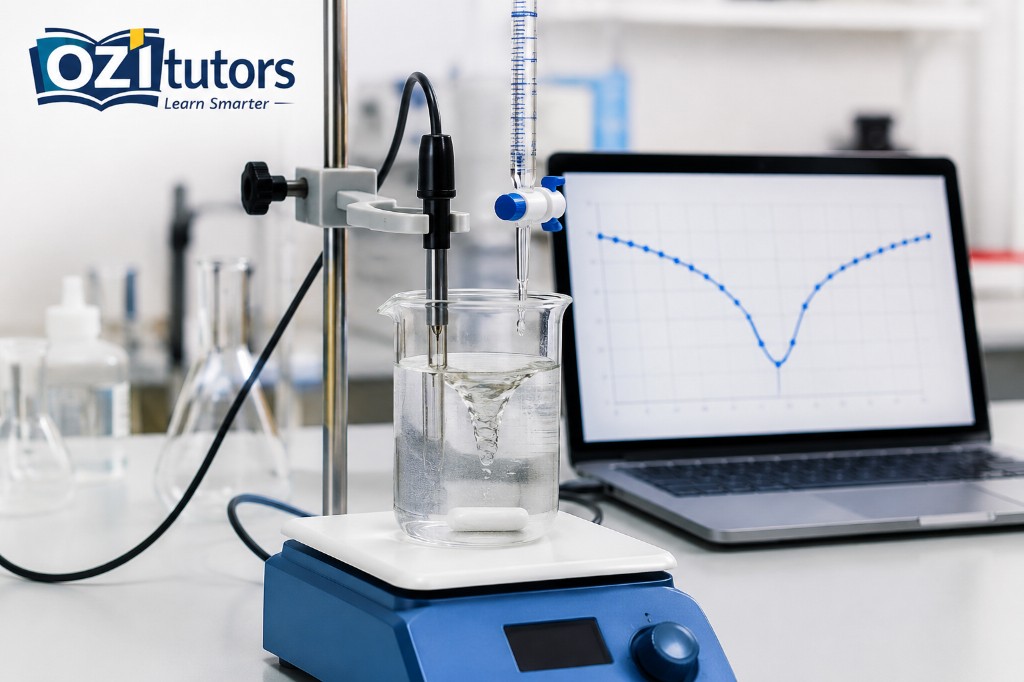
Weak acid–strong base titrations produce different curves because the weak acid contributes fewer ions initially and buffering effects matter. AP questions may show a graph and ask you to identify the equivalence point or explain a trend—always tie your answer to changing ion identity and concentration.
Common Misconceptions
- “All acids conduct equally well.” False. Strength and concentration both matter.
- “Molecular acids never conduct.” Some do slightly if they partially ionize; others (like pure HF in low water) conduct poorly.
- “Bases always conduct more than acids.” Compare specific solutions. NaOH and HCl at equal molarity both dissociate strongly and conduct well.
Lab and Exam Tips
When interpreting conductivity data:
- Identify whether each solute is a strong or weak electrolyte.
- Compare molarities if given.
- Watch for polyatomic ions that contribute multiple charges (SO₄²⁻ vs. Cl⁻)—higher charge can increase conductivity at equal molarity.
- Link macroscopic observations (bright bulb vs. dim bulb) to particle-level ion counts.
Conductivity bridges the visible world of circuits with invisible ion chemistry. Master that link, and you will handle both lab-based FRQs and multiple-choice ranking questions with a clear, evidence-based approach.
Get help with AP Chemistry
If conductivity graphs or strong vs weak electrolyte questions still feel fuzzy, a short demo with a verified chemistry tutor can lock in the ion story faster than rereading alone.