

Calendar date: 2026-07-24
Slug: mcq-vs-frq-what-every-student-needs-to-know
Seed keyword: mcq vs frq
Domain: babylovegrown
Advanced Placement and many college-entrance exams mix multiple-choice questions (MCQs) and free-response questions (FRQs). Both formats measure subject mastery, but they reward different habits. Understanding the MCQ vs FRQ divide helps you study smarter, manage time, and avoid strategies that work for one section and hurt the other.
Whether you are preparing alone or with an online tutor, treat the two formats as complementary skills—not the same test twice.
What each format actually tests
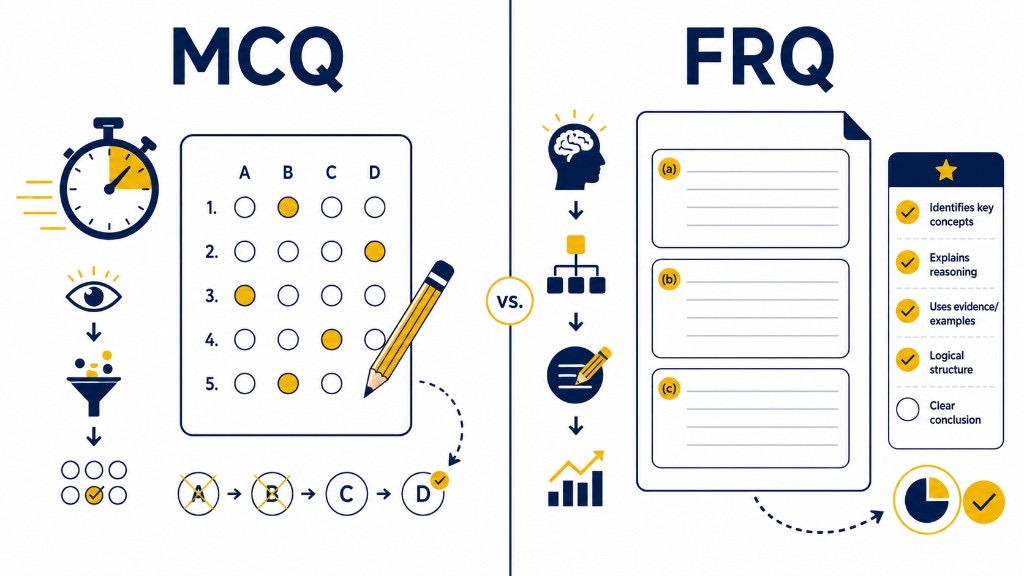
Multiple-choice questions (MCQs)
MCQs emphasize breadth, speed, and discriminating among close options. You must recognize the best answer quickly from a stem that may include charts, excerpts, or experimental setups.
Typical challenges:
- Trap answers that are partially true
- Data interpretation under time pressure
- Vocabulary precision (especially science and history)
Scoring is usually all or nothing per question—no partial credit.
Free-response questions (FRQs)
FRQs emphasize depth, explanation, and process. You construct the answer: show work, justify with evidence, interpret results, or build an argument across paragraphs.
Typical challenges:
- Explaining why, not just stating what
- Managing multi-part rubrics (each part scored separately)
- Writing clearly when tired at the end of the exam
Scoring uses partial credit—method, setup, or one correct step can earn points even if the final answer is wrong.
Time management: two different mindsets
| MCQ mindset | FRQ mindset |
|---|---|
| Keep moving; flag and return | Read the entire prompt before writing |
| Eliminate wrong choices | Label parts (a), (b), (c) explicitly |
| Do not over-invest in one hard item | Budget minutes per part based on point values |
| Answer every question (no penalty on most AP MCQs) | Quality beats length—target rubric verbs |
Many students leave FRQ points on the table by skipping verbal explanation in math/science or by writing generic introductions in history essays.
Study approaches that should differ
For MCQs:
- Drill released questions by topic to spot patterns.
- Keep an error log: content gap vs. misread question.
- Practice pacing—roughly one minute per item in many sciences, slightly more in reading-heavy sections.
For FRQs:
- Use official scoring guidelines and sample responses; highlight where partial credit is awarded.
- Memorize linking phrases: “because,” “which shows,” “therefore,” connecting claim to evidence.
- For calculations, write formula → substitution → units → reasonable significant figures.
Cramming definitions helps MCQs more than FRQs. FRQs need rehearsed explanation habits.
Skills that transfer—and skills that do not
Some abilities transfer across formats:
- Graph and table literacy appears everywhere.
- Experimental design vocabulary (control, independent variable) matters in science MCQs and FRQs.
- Thesis and contextualization anchor history essays and also help with Seminar-style prompts.
But guessing strategically belongs to MCQs; showing intermediate steps belongs to FRQs.
Exam-day tactics
MCQ section: If stuck, narrow to two choices, pick one, mark for review, and move on. Spiraling burns time your FRQ section may need later.
FRQ section: Answer every part you can. Blank sections score zero. If part (c) is hard, still attempt (d). Use bullet points where prose is not required—unless the rubric demands complete sentences.
How tutors and teachers can help
Ask for separate feedback on MCQ error logs and FRQ drafts. A student who scores 90% on MCQs but 50% on FRQs usually needs writing structure, not more flashcards.
On OziTutors, verified instructors can run timed drills for one format and rubric walkthroughs for the other in the same week—so practice matches the skill you are actually missing.
Bottom line
MCQs and FRQs are not two versions of the same test—they are complementary filters. Train speed and elimination for one; train explanation and rubric alignment for the other. Master both formats separately, and your composite score reflects true subject mastery rather than a single lucky style.
Get help with exam prep
If MCQ pacing or FRQ rubrics still feel fuzzy, a short demo with a verified tutor can lock in format-specific strategies faster than rereading alone.