
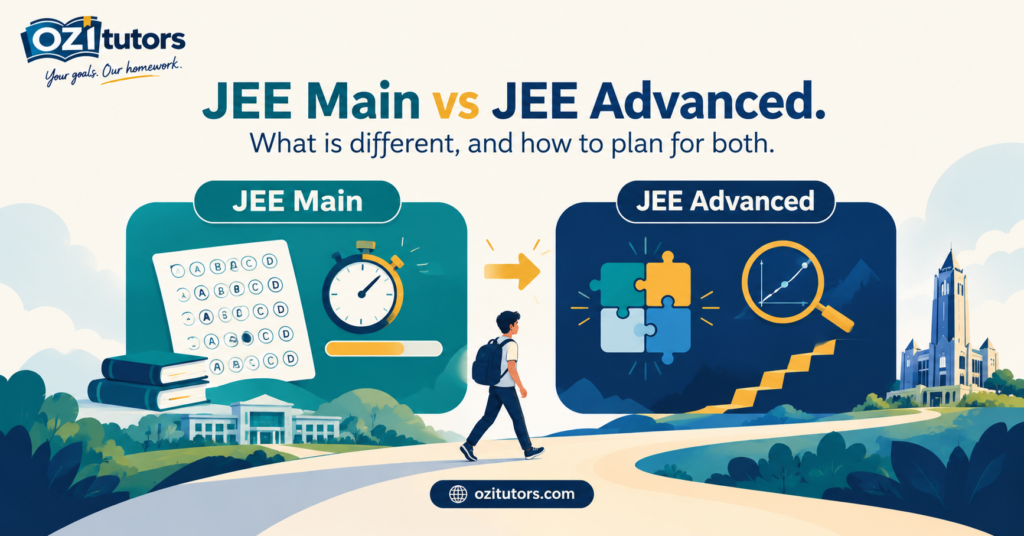
| JEE Main is conducted by the NTA and leads to admission to NITs, IIITs and other centrally funded institutes. It is also the qualifying test for JEE Advanced, which is conducted by one of the IITs and leads to IIT admission. Advanced is harder and tests deeper problem-solving. Most students prepare for both together |
Students often say “JEE” as if it were one exam. It is two. The two exams have different jobs, different difficulty levels and different rules. Once you see how they connect, you can plan your preparation with less confusion.
What is JEE Main?
JEE Main is the first stage. It is conducted by the National Testing Agency (NTA). It is held in more than one session in a year. Your Main result is used for admission to NITs, IIITs and several other centrally funded technical institutes, based on the counselling process. It is also the exam that decides whether you can appear for JEE Advanced.
What is JEE Advanced?
JEE Advanced is the second stage. It is conducted by one of the IITs, and the organising IIT changes each year. Only students who qualify through JEE Main can appear. Your Advanced result is used for admission to the IITs.
The main differences
Who conducts it. Main is conducted by the NTA. Advanced is conducted by an IIT chosen on rotation.
Who can appear. Anyone who meets the basic eligibility can appear for Main. For Advanced, you need to be among the top group of Main qualifiers. The number is announced each year, so check the official notice.
Difficulty. Main tests core concepts and speed across the syllabus. Advanced tests deeper understanding, and its questions often combine ideas from more than one chapter.
Question style. Main is mostly multiple-choice with a numerical section. Advanced uses several question types, and the pattern can change from year to year.
Number of attempts. There are limits on how many times and in how many years a student can attempt each exam. These limits are set by the official bodies, so read the current rules.
What they lead to. Main leads to NITs, IIITs and other institutes. Advanced leads to IITs. Many students who miss the Advanced cut-off still get good options through Main.
Is the syllabus the same?
There is a large overlap, because both are built on the Class 11 and Class 12 syllabus in physics, chemistry and maths. But the depth is different. A topic that needs two direct formulas in Main might need a full multi-step argument in Advanced. Advanced may also include topics or approaches that Main treats lightly.
How should you plan for both?
The best plan is layered.
- Build the base first. Strong concepts help in both exams. Do not rush to Advanced-level problems before the basics are firm.
- Practise Main-style speed and accuracy. You need to be quick and careful across the whole syllabus.
- Add Advanced-level problem-solving. Once a chapter feels comfortable, solve harder problems that combine ideas.
- Use Main as a checkpoint. Your Main result tells you how ready you are and whether Advanced is realistic this year.
- Keep a backup plan in mind. Know which NITs and other institutes fit your Main rank so that you are not planning around a single result.
What about Class 12 boards?
Both exams sit alongside boards. Board preparation, especially for physics, chemistry and maths, overlaps a lot with the base you need for JEE. A weekly plan that reserves time for both usually works better than switching between them in blocks.
What NRI and international students should know
Students outside India can appear for JEE Main from centres abroad in many countries, subject to the exam notice. For admission to NITs and other institutes through the DASA route, there are separate rules and a separate counselling process. Check the official DASA site for eligibility. OziTutors has a DASA and CIWG college predictor page if you want to explore likely options.
Common mistakes
- Treating Advanced as “harder Main” and only solving tough questions.
- Ignoring the Main syllabus while chasing Advanced.
- Not reading the eligibility rules until late.
- Comparing with friends who are at a different stage.
Getting help
If you are unsure how to split your time between the two exams, a mentor can help you build a plan around your current level. That plan might look different for a student who scores 120 in a mock than for one who scores 200.
FAQ
Can I skip JEE Main and appear directly for JEE Advanced?
No. Advanced requires qualifying through JEE Main first.
Is JEE Advanced only for IITs?
It is the entry route for IITs. Some other institutes also use the Advanced rank for admission, so check each institute’s rules.
Do I need coaching for both?
Not necessarily. Some students prepare with school, self-study and a tutor. What matters is regular practice and honest review.
How many times can I attempt JEE Advanced?
There are official limits. Read the latest eligibility rules on the JEE Advanced website.
| Not sure how to split your time between JEE Main and JEE Advanced? Book a free demo session with an OziTutors mentor, and explore your likely options with our DASA and CIWG college predictor. |