Understand the IGCSE grading system 2026, 9–1 scale, grade boundaries and pass marks, plus practical study tips to help you aim for a Grade 9.
Why IGCSE Grading Confuses So Many Parents
Open two different IGCSE report cards and you might see a “7” on one and a “B” on the other : for the exact same level of performance. That’s not an error. It’s because IGCSE grading isn’t a single unified scale; it depends on which exam board set the paper and which subject it belongs to.
Cambridge International has been phasing in the numeric 9–1 scale subject by subject rather than switching everything at once: so the older A*–G letter scale and the newer 9–1 scale currently run side by side. Edexcel: by contrast: moved its entire International GCSE catalogue to 9–1 across the board. Here’s the plain:English breakdown parents and students actually need.
The 9–1 Scale: Decoded
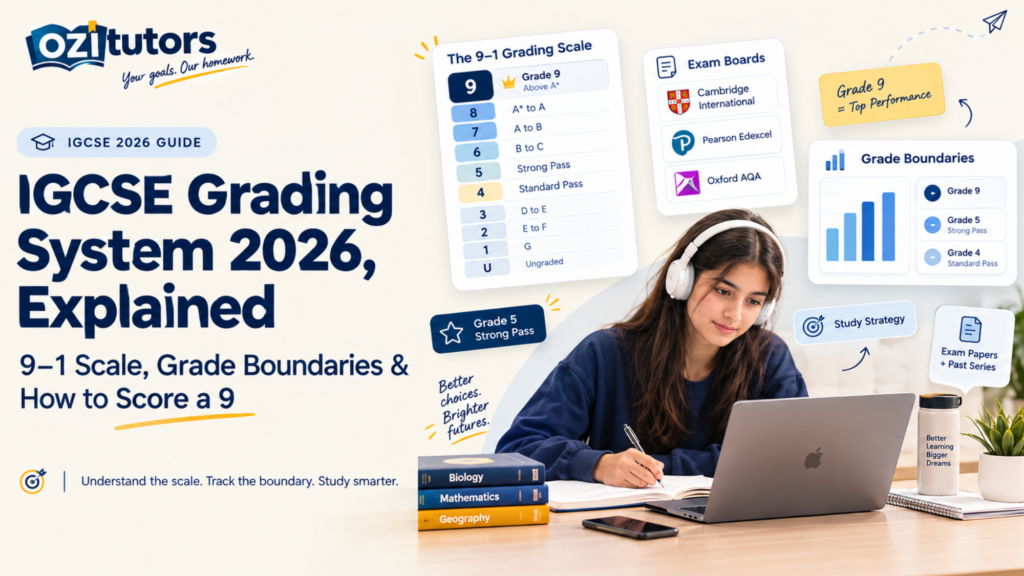
▪ Grade 9: Above A* : exceptional: the top slice of high performers.
▪ Grade 8 / 7: A* to A equivalent : excellent to strong performance.
▪ Grade 6 / 5: B to strong C equivalent : good; Grade 5 is described as a “strong pass.”
▪ Grade 4: C equivalent : the standard / minimum pass: widely used as a benchmark.
▪ Grade 3 / 2 / 1: D to F/G equivalent : below the standard pass.
▪ Grade U: Ungraded : below Grade 1.
How Cambridge grades IGCSE (checked 14 October 2026): Cambridge IGCSEs are graded A*–G around the world. A 9–1 version is offered as a separate syllabus code for some popular subjects, mainly for schools in the UK, and schools can keep A*–G. For example, Biology 0610 is graded A*–G and Biology 0970 is graded 9–1. Cambridge sets 9–1 grades so that 7 aligns with A, 4 with C and 1 with G, and publishes grade threshold tables after every exam series. Labels such as “standard pass” (4) and “strong pass” (5) come from GCSEs in England, not from Cambridge. Source: Cambridge International grading choice.
Good to know: Grade 4 is treated as the standard pass and Grade 5 as the strong pass : schools: colleges and employers commonly quote one of these two grades as an entry requirement: so it’s worth knowing exactly which one a target school is asking for.
Cambridge vs Edexcel vs Oxford AQA: What’s Different
- Cambridge International: phasing in 9–1 grading subject by subject : so a student’s report card can legitimately show both 9–1 and A*–G grades in the same year: depending on subject.
- Pearson Edexcel: moved its entire International GCSE syllabus to the 9–1 scale across the board: so results are consistently numeric.
- Oxford AQA International: uses the same 9–1 structure as UK GCSEs: with Grade 4 as the standard pass and Grade 5 as the strong pass : boundaries are published after every June and November series.
How a Raw Mark Becomes a Grade
Every IGCSE paper is first marked as a raw score out of the maximum for that component. After each exam series: senior examiners set grade boundaries : the minimum raw mark needed for each grade : so that a 9 in one year represents the same standard of work as a 9 the year before: even if that year’s paper was slightly harder or easier.
This is why grade boundaries move a little each session. As a real example: in the June 2026 series: Cambridge IGCSE Biology’s Paper 21 needed a raw mark of 35 out of 40 for a grade 9: while Geography’s Paper 12 needed 61 out of 75. The percentage required for a 9 is never identical across subjects or components : which is exactly why chasing “90%” as a universal target is the wrong mental model.
7 Ways to Push a Grade Up (Genuinely: Not Just Cramming)
1. Know your subject’s real threshold : Don’t study to “90%” : study to your subject’s actual published boundary. A 9 in one component can need fewer raw marks than an 8 in another.
2. Practise on multiple past series: not one : Grade boundaries are set relative to that year’s paper difficulty. Practising on the last 3–4 series (not just the most recent one) shows the real range of question styles examiners use.
3. Master command:word technique : Cambridge and Edexcel mark schemes reward specific command words (“explain:” “evaluate:” “describe”) differently : losing marks here is rarely a knowledge gap: it’s a technique gap.
4. Don’t neglect non:written components : Components like coursework: orals and practicals often have separate: more generous boundaries : students chasing a 9 frequently under:invest here relative to the marks on offer.
5. Self:mark with the real mark scheme : A levelled: examiner:style mark scheme applied to your own timed answers exposes exactly where marks are being lost : vague description vs precise: evidenced argument.
6. Build a paper:specific timing plan : Papers with multiple structured questions punish poor time allocation more than poor knowledge : a rushed final question can cost more than a shaky first one.
7. Get boundary:aware subject coaching : A subject tutor who tracks boundary movement across series can tell a student: precisely: how many raw marks separate their mock from the grade they want.
FAQs
Get help moving up a grade
Once you know which scale and syllabus code your school uses, compare the student’s recent paper marks with the latest Cambridge grade threshold table to see how many marks separate the current grade from the target.
OziTutors currently has only a few IGCSE tutors, mainly for Physics and Mathematics. Browse IGCSE support on OziTutors and confirm a tutor is available for your syllabus before booking a free first lesson.
Is Grade 4 a pass in IGCSE?
Yes : Grade 4 is treated as the standard pass on the 9–1 scale: while Grade 5 is considered a strong pass and is what many competitive sixth forms and colleges look for.
Are Cambridge and Edexcel IGCSE grades equivalent?
They sit on comparable 9–1 (or 9–1/A*–G) scales: but each board sets its own grade boundaries independently after every series: so a student should always check the specific board and syllabus code: not assume the two are interchangeable mark:for:mark.
Why do IGCSE grade boundaries change every year?
Boundaries are reset each series so that a given grade always represents a consistent standard of achievement: regardless of whether that year’s paper was slightly harder or easier than the last.
Aiming for a 9 this series?
Visit Ozitutors.com to start a free IGCSE subject assessment →
Ozitutors’ IGCSE tutors track live grade,boundary data across Cambridge,Edexcel and Oxford AQA to build a subject, specific plan : not a generic “study harder” checklist.