
RMS CET 2026: Complete Guide to Rashtriya Military School Admission for Class VI & IX
The National Testing Agency (NTA) has released the official notification for the Rashtriya Military School Common Entrance Test (RMS CET) 2026, inviting applications for admission to Class VI and Class IX for the 2027–2028 academic session. This guide goes beyond the basic dates : it breaks down the exact syllabus, subject-wise marks, reservation policy, and fee structure so parents and students know exactly what they’re preparing for.
What Is RMS CET and Why It Matters
Rashtriya Military Schools (RMS) are English-medium, CBSE-affiliated, fully residential public schools run by the Ministry of Defence (Army). Founded in 1925, they are among the oldest public schools in India and are founding members of the Indian Public Schools’ Conference. Admission to Class VI and IX is decided entirely through RMS CET : a national entrance exam conducted by NTA, followed by a medical examination and interview conducted by the schools themselves.
Beyond CBSE board preparation, RMS schools are specifically structured to build a foundation for entry into the National Defence Academy (NDA) and the Armed Forces, making them a distinctive choice for families with a defence background or aspiration.
There are five Rashtriya Military Schools in India: RMS Chail in the Shimla Hills of Himachal Pradesh, RMS Ajmer and RMS Dholpur in Rajasthan, and RMS Belgaum and RMS Bengaluru in Karnataka.
RMS CET 2026: Important Dates
The online application process started on 23 September 2026 and will remain open until 20 October 2026 (up to 5:00 PM). The examination fee must be paid by 20 October 2026, 11:50 PM. Candidates who miss this deadline get one more chance through a late application window from 21 to 25 October 2026 (up to 5:00 PM), though this comes with a late fee of ₹500. The RMS CET written examination itself will be held on 13 December 2026, a Sunday.
Eligibility Criteria
Age is calculated as on 31 March 2027. For Class VI, candidates must be between 10 and 13 years old, meaning they should be born between 1 April 2014 and 31 March 2017. For Class IX, candidates must be between 13 and 16 years old, born between 1 April 2011 and 31 March 2014.
A six-month age relaxation on the upper limit applies to wards of Armed Forces personnel Killed in Action (KIA). Both boys and girls, and wards of both defence personnel and civilians, are eligible to apply.
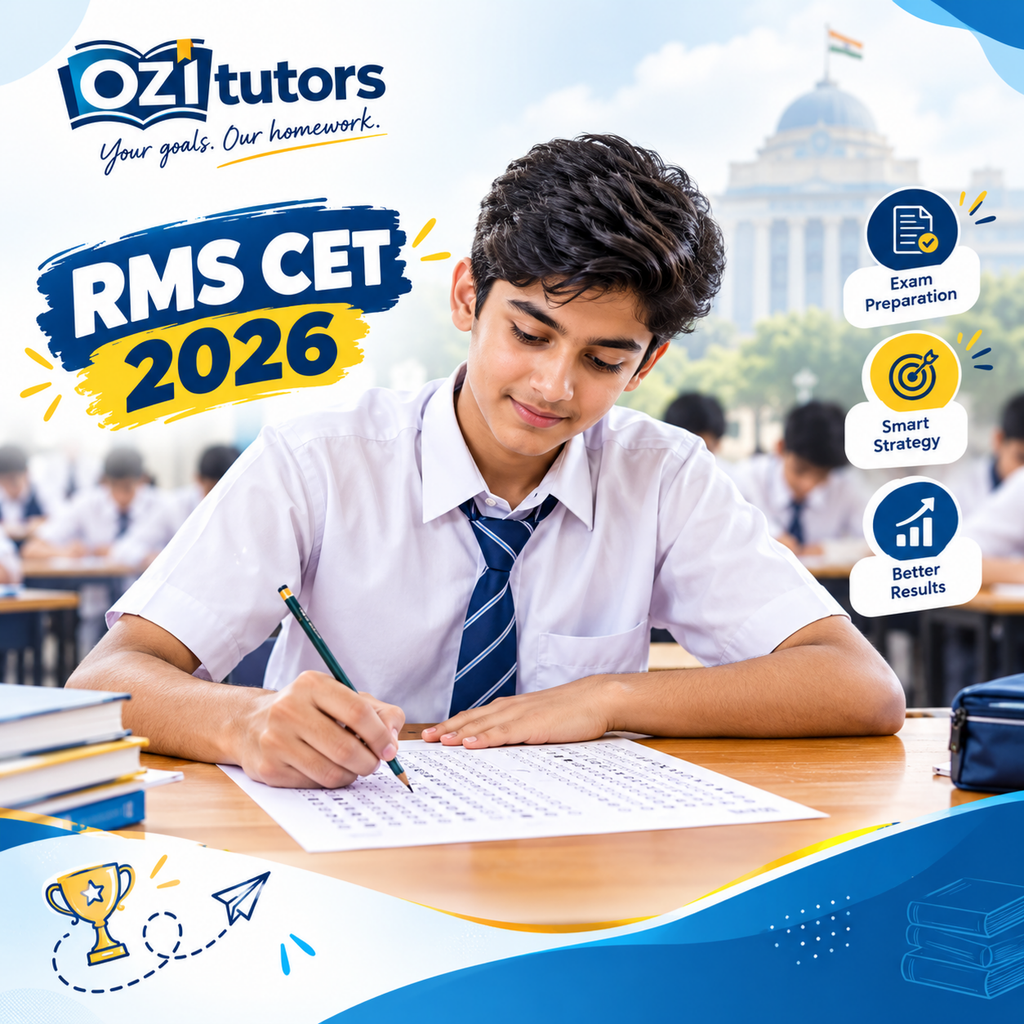
RMS CET 2026 Exam Pattern : In Detail
The written exam is OMR-based with Multiple Choice Questions, and there is no negative marking. It is conducted across 63 cities in India, and the overall duration is 2 hours 30 minutes.
For Class VI (based on Class V level, 200 total marks): the paper has four sections of 50 marks each : English, Intelligence Test, Mathematics, and General Knowledge & Current Affairs. English requires only 35% to qualify, and importantly, English marks are not counted in the final merit list : merit is decided purely by Intelligence, Mathematics, and GK scores. The other three sections require 40% to qualify. On top of the written paper, there’s a 20-mark Interview, where candidates need at least 50% to pass. The Class VI paper is bilingual, in both English and Hindi.
For Class IX (based on Class VIII/NCERT level, 200 total marks): the exam is split into two papers. Paper 1 covers English (50 marks), Hindi (20 marks), and Social Science (30 marks), totalling 100 marks. Paper 2 covers Mathematics (50 marks) and Science (50 marks), also totalling 100 marks. Both papers independently require a minimum 50% qualifying score. There’s also a 50-mark Interview for Class IX. The Class IX question paper is in English only.
Detailed Syllabus Breakdown
Class VI syllabus covers: English : antonyms, synonyms, comprehension, fill in the blanks, grammar, spelling, and sentence framing; Mathematics : number system, basic arithmetic, geometry, mensuration, and data handling at Class V level; Intelligence Test : pattern recognition, analogies, classification, and logical reasoning; and General Knowledge & Current Affairs : history, geography, civics, famous personalities and places, important dates and days, current affairs, and India’s states, union territories and rivers.
Class IX syllabus covers: English : grammar, comprehension, vocabulary, tenses, articles, error correction, and composition; Hindi : व्याकरण (संधि, समास, अलंकार), अपठित गद्यांश, मुहावरे, and पर्यायवाची शब्द; Social Science, Mathematics, and Science : all aligned to the Class VIII NCERT syllabus, covering History, Geography, Civics and Economics for Social Science; algebra, geometry, mensuration, data handling and number system for Mathematics; and Physics, Chemistry and Biology for Science.
Reservation Policy
Seats are distributed by category as follows: 70% for wards of serving or retired JCOs and Other Ranks of the Army, Navy and Air Force (the “Entitled Category”), 20% for wards of officers, and 10% for civilians. Within these, standard Government of India reservations apply : OBC-NCL 27%, SC 15%, and ST 7.5%. A total of 50 seats across all five schools (no more than 15 in any one school) are reserved for wards of personnel Killed in Action. Girls get 10% of seats for Class VI (capped at 30 seats) and 10% for Class IX, counted across all five schools together.
Selection Process : Four Stages
Selection runs through four stages. Stage I is the Written Exam, conducted by NTA, OMR-based with no negative marking. Stage II is the Medical Examination, held at a nominated Military or Command Hospital. Stage III is the Interview, conducted by RMS : 20 marks for Class VI and 50 marks for Class IX, with a minimum 50% required to pass. Stage IV is the Final Merit List, where written and interview marks are combined into a category-wise merit list that decides school allotment based on available vacancies.
Application Fee
The application fee is ₹1,000 for General, OBC and OBC (NCL) candidates, and ₹750 for SC, ST, and wards of Armed Forces personnel. Payment is accepted via Credit Card, Debit Card, Net Banking, or UPI.
School Fee and Scholarships (Post-Admission)
School fees are paid directly to the allotted RMS at the time of admission, and the fee structure varies slightly by category : entitled, officer wards, and civilian. No fee is charged for wards of officers, JCOs, or Other Ranks (or Navy/Air Force equivalent ranks) who were Killed in Action. Caution money is fully refundable, without interest, to the cadet on discharge from the school. Additionally, 15% of non-entitled cadets (wards of officers and civilians) are awarded means-cum-merit scholarships based on a common scholarship test.
How to Apply for RMS CET 2026
Visit the official NTA portal at exams.nta.nic.in/rmscet/ and register using the parent or guardian’s mobile number and email ID. Fill in the candidate’s personal, academic, and category details, then upload the photograph and signature in the prescribed format. Pay the application fee online, and download and save the confirmation page for future reference.
Read the official Common Prospectus and Information Bulletin on the NTA portal carefully before applying : it contains sample OMR sheets and sample questions for practice.
How to Prepare : A Practical Strategy
Start with the NCERT basics for the relevant class level : Class V for Class VI aspirants, Class VIII for Class IX aspirants : since the syllabus is directly aligned to these. Prioritise the merit-counted subjects: for Class VI, since English doesn’t count toward merit, spend proportionally more time on Intelligence, Mathematics, and GK once the English qualifying bar is comfortably met. Practice OMR-format mock tests regularly : since there’s no negative marking, attempting every question, with informed guessing where needed, is a sound strategy. Build a daily current affairs habit for the GK section, since RMS CET draws heavily on recent events, defence-related news, and static GK. Finally, take timed sectional tests to manage the 2-hour-30-minute written exam efficiently across four subjects.
How OziTutors Can Help Your Child Crack RMS CET 2026
With the exam scheduled for 13 December 2026, students have a focused preparation window of about 11 weeks. OziTutors’ RMS CET program is built around this exact syllabus and includes subject-wise concept building mapped precisely to the Class V / Class VIII syllabus used by RMS CET, full-length OMR-based mock tests with detailed performance analytics, personalised doubt-clearing sessions, and interview and personality-development coaching for Stage III.
Enroll today and give your child a structured, syllabus-aligned head start.
Frequently Asked Questions
Q1. What is the last date to apply for RMS CET 2026? 20 October 2026 (5:00 PM), with fee payment allowed till 11:50 PM the same day. A late window (with ₹500 late fee) runs from 21–25 October 2026.
Q2. When will RMS CET 2026 be conducted? 13 December 2026 (Sunday).
Q3. Does English count in the merit list for Class VI? No. English is qualifying only (35% required) for Class VI : it is not added to the merit score.
Q4. Is there negative marking in RMS CET? No, there is no negative marking in the written exam.
Q5. What percentage of seats are reserved for girls? 10% of seats for Class VI (max 30) and 10% for Class IX, across all five schools combined.
Q6. Can civilians (non-defence families) apply? Yes, 10% of seats are reserved for civilian wards, subject to standard GOI category reservations.