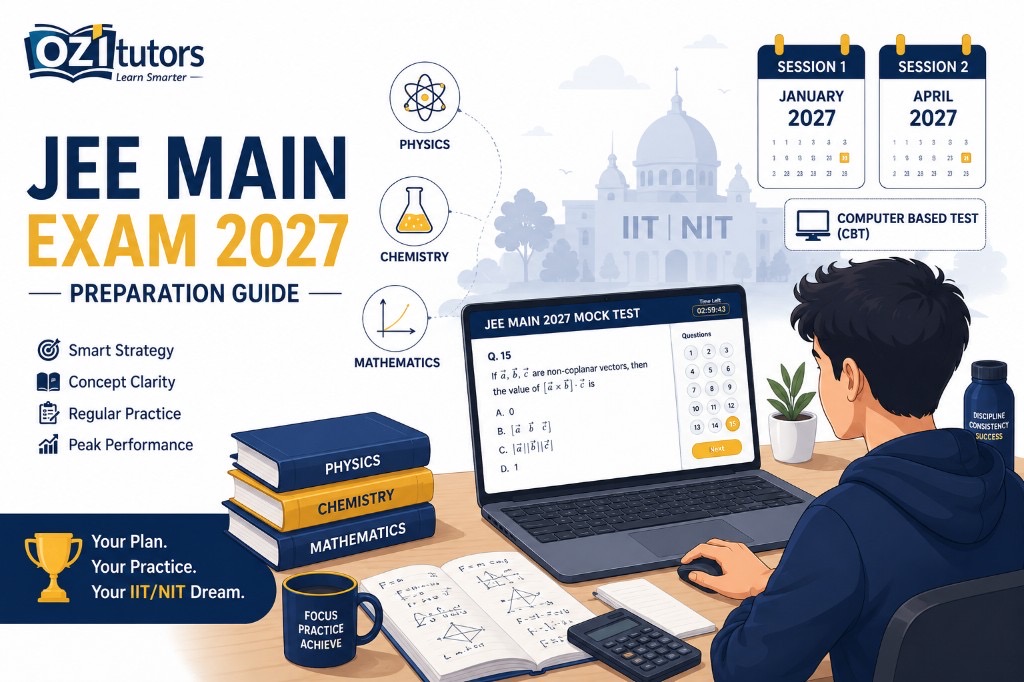
JEE Main 2027 is India’s largest engineering entrance exam, conducted by the National Testing Agency (NTA) for admission to B.E./B.Tech., B.Arch., and B.Planning programmes at NITs, IIITs, GFTIs, and as the qualifying gateway to JEE Advanced for IITs. If you are searching for JEE Main exam 2027 dates, eligibility, or a practical study plan, this guide brings together what is confirmed today and what is expected based on recent NTA cycles.
Note: NTA has not released the official JEE Main 2027 notification yet. All session dates below are expected until published on jeemain.nta.nic.in. Check the official site before booking travel or finalising your preparation calendar.
JEE Main 2027 at a Glance
| Particular | Details |
|---|---|
| Exam name | Joint Entrance Examination (Main) 2027 |
| Conducting body | National Testing Agency (NTA) |
| Expected sessions | Session 1: January 2027 · Session 2: April 2027 |
| Mode | Computer-Based Test (CBT); drawing section of B.Arch. may include pen-and-paper |
| Paper 1 subjects | Physics, Chemistry, Mathematics |
| Paper 1 total marks | 300 (if current pattern continues) |
| Official website | jeemain.nta.nic.in |
| Counselling | JoSAA / CSAB after results |
JEE Main 2027 Expected Exam Dates (Session 1 and Session 2)
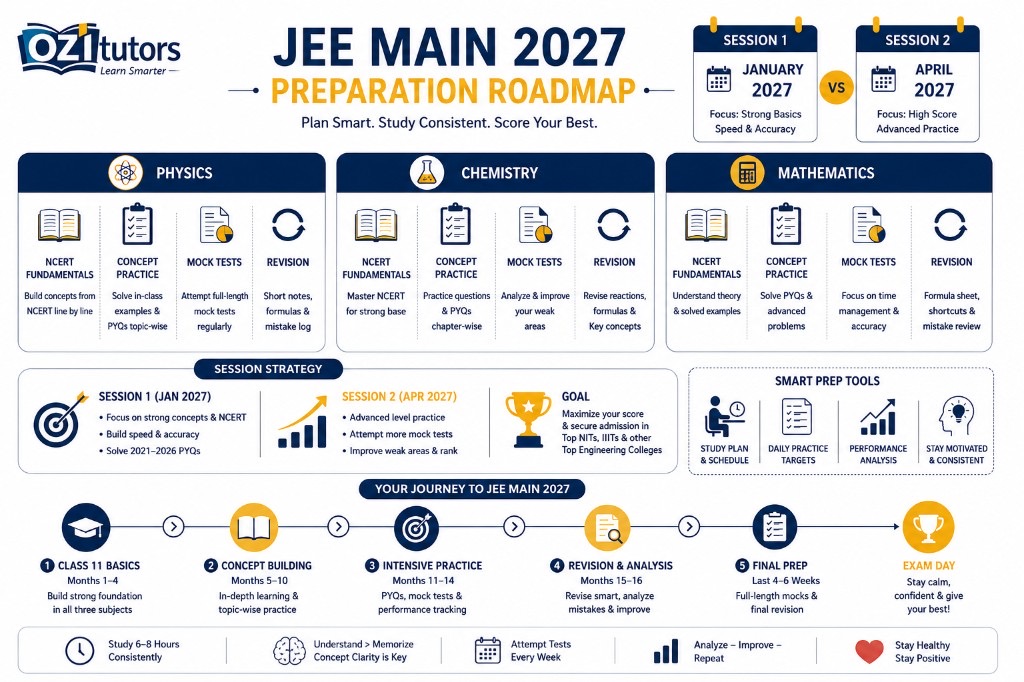
NTA typically runs JEE Main twice a year. Based on the 2025–2026 pattern, JEE Main exam 2027 is likely to follow this timeline:
Session 1 (January 2027)
| Event | Expected timeline |
|---|---|
| Notification and registration open | October 2026 |
| Last date to apply and pay fee | November 2026 |
| Form correction window | November–December 2026 |
| City intimation slip | Early January 2027 |
| Admit card | 3–4 days before exam |
| JEE Main 2027 Session 1 exam | Late January 2027 (multiple days/shifts) |
| Provisional answer key | February 2027 |
| Session 1 result | Mid-February 2027 |
Session 2 (April 2027)
| Event | Expected timeline |
|---|---|
| Session 2 registration opens | January–February 2027 |
| Last date to apply | February–March 2027 |
| Admit card | Late March / early April 2027 |
| JEE Main 2027 Session 2 exam | Early to mid-April 2027 |
| Answer key and result | April–May 2027 |
Why two sessions matter: You can attempt both. NTA generally uses your best percentile across sessions for rank and JEE Advanced eligibility. Session 2 is a valuable second chance if Session 1 did not reflect your preparation level.
Who Can Apply for JEE Main 2027?
Eligibility rules are set in the official information bulletin. Historically, candidates must:
- Have passed Class 12 (or equivalent) with Physics, Mathematics, and Chemistry/Biology/Biotechnology/Technical Vocational subject, or be appearing in 2027.
- Meet age and attempt limits as notified by NTA (check the 2027 bulletin—do not rely on outdated third-party pages).
- Score above the JEE Main cutoff percentile if you aim for JEE Advanced (only the top rank holders among JEE Main qualifiers are eligible; the exact number is announced each year).
If you are in Class 11 or 12, align your school board syllabus (CBSE, ICSE, or state board) with the JEE Main syllabus early—most gaps come from starting too late in Mechanics, Organic Chemistry, or Coordinate Geometry.
JEE Main 2027 Exam Pattern (Paper 1 – B.E./B.Tech.)
While NTA may tweak details in the notification, Paper 1 has recently followed this structure:
| Section | Questions (approx.) | Marks |
|---|---|---|
| Physics | 25–30 | 100 |
| Chemistry | 25–30 | 100 |
| Mathematics | 25–30 | 100 |
| Total | 75–90 | 300 |
Question types usually include:
- Multiple Choice Questions (MCQs) with four options
- Numerical Value Answer questions where you enter a number (no negative marking in many recent cycles for NVAs—verify in the 2027 brochure)
Marking scheme (typical): +4 for a correct MCQ, −1 for an incorrect MCQ; numerical questions may have no negative marking. Always confirm in the official mock test and information bulletin.
Duration: 3 hours. Plan for stamina—full-length CBT mocks are non-negotiable in the last three months.
JEE Main 2027 Syllabus Overview
The JEE Main syllabus is grounded in NCERT Classes 11 and 12 for PCM, with some topics emphasised more heavily in JEE than in board exams.
Physics (high-weight areas)
- Kinematics, Laws of Motion, Work–Energy–Power
- Rotational Motion, Gravitation
- Thermodynamics, Kinetic Theory
- Electrostatics, Current Electricity, Magnetism
- Electromagnetic Induction, AC
- Optics, Modern Physics (dual nature, atoms, nuclei)
Chemistry
- Physical: Mole concept, equilibrium, thermodynamics, electrochemistry, chemical kinetics
- Organic: General principles, hydrocarbons, functional groups, biomolecules
- Inorganic: Periodic table, chemical bonding, coordination compounds, d- and f-block
Mathematics
- Algebra, complex numbers, quadratic equations
- Calculus (limits, continuity, differentiation, integration, differential equations)
- Coordinate geometry and 3D geometry
- Vectors, statistics, probability
Practical tip: Maintain a chapter-wise weightage tracker from past papers. Do not treat all chapters equally in the final 90 days—prioritise high-yield topics once your basics are secure.
How to Prepare for JEE Main Exam 2027
Class 11 students (starting now)
Build conceptual depth, not just formula sheets. For each chapter:
- Read NCERT once for language and definitions.
- Solve level-1 → level-2 problems before jumping to Advanced-level books.
- Take a monthly diagnostic to find weak units (many students hide weak Organic Chemistry until it is too late).
Class 12 and drop-year students
Your calendar should balance board exams (if applicable) and JEE:
| Phase | Focus |
|---|---|
| Now – Oct 2026 | Complete syllabus once; maintain error log |
| Nov 2026 – Jan 2027 | Session 1 mocks; speed + accuracy |
| Feb – Apr 2027 | Session 2 revision; previous-year papers |
Daily minimum (serious aspirant): 6–8 focused hours with one full mock every week in the last two months before each session.
Mock tests and analysis
A mock test without analysis wastes time. After every test, tag errors as concept, calculation, or time pressure. Fix the largest bucket first.
JEE Main vs JEE Advanced: Know the Difference
| JEE Main 2027 | JEE Advanced 2027 | |
|---|---|---|
| Purpose | NITs, IIITs, GFTIs; JEE Advanced qualifier | IIT admission |
| Difficulty | Broad Class 11–12 PCM; speed matters | Deeper, multi-concept problems |
| Attempts | Up to 3 consecutive years (verify in bulletin) | 2 attempts in 2 consecutive years |
| When | January & April 2027 | Expected mid-May 2027 (after Main results) |
Clearing JEE Main with a strong percentile is step one. If IIT is your goal, reserve April–May 2027 for Advanced-specific problem practice.
Registration Checklist (When Forms Open)
- Valid email and mobile number (OTP-linked)
- Class 10 and 12 details, category certificate if applicable
- Scanned photograph and signature per NTA specifications
- Payment via listed modes—complete fee in one transaction before the deadline
- Download confirmation page and note application number
Registration windows are short. Set a reminder for October 2026 for Session 1.
Frequently Asked Questions
When will JEE Main 2027 be held?
Session 1 is expected in January 2027 and Session 2 in April 2027. Official dates will appear on jeemain.nta.nic.in.
Is JEE Main 2027 syllabus reduced?
Follow the latest NTA information bulletin. Do not rely on unverified “syllabus deleted” lists on social media.
Can I appear in both sessions?
Yes, in recent years candidates could register for Session 1, Session 2, or both; the better percentile is often used.
What percentile is needed for JEE Advanced?
The cutoff varies by category and year. NTA/JAB announces the qualifying threshold after results—track official announcements only.
How is JEE Main different from board exams?
JEE rewards application and speed across mixed topics in one sitting. Board exams are more structured by chapter and allow longer descriptive answers.
Get Structured JEE Main 2027 Support
Find verified online tutors on OziTutors for personalised 1-to-1 exam preparation.
Self-study works when your plan is disciplined—but personalised doubt clearing and weekly accountability often decide rank jumps in the last six months.
OziTutors connects Class 11–12 students with verified Physics, Chemistry, and Maths tutors for JEE Main and foundation prep. Book a free demo class, get a chapter-wise roadmap, and match with a tutor who fits your pace—whether you need intensive problem-solving or NCERT-to-JEE concept bridging.
Next step: Start with one diagnostic mock, map weak chapters, and align your calendar to Session 1 (January 2027) and Session 2 (April 2027) today—not after the registration deadline.